The Main Reason Mortgage Rates Are So High
Today’s mortgage rates are top-of-mind for many homebuyers right now. As a result, if you’re thinking about buying for the first time or selling your current house to move into a home that better fits your needs, you may be asking yourself these two questions:
- Why Are Mortgage Rates So High?
- When Will Rates Go Back Down?
Here’s context you need to help answer those questions.
1. Why Are Mortgage Rates So High?
The 30-year fixed-rate mortgage is largely influenced by the supply and demand for mortgage-backed securities (MBS). According to Investopedia:
“Mortgage-backed securities (MBS) are investment products similar to bonds. Each MBS consists of a bundle of home loans and other real estate debt bought from the banks that issued them . . . The investor who buys a mortgage-backed security is essentially lending money to home buyers.”
Demand for MBS helps determine the spread between the 10-Year Treasury Yield and the 30-year fixed mortgage rate. Historically, the average spread between the two is 1.72 (see chart below):
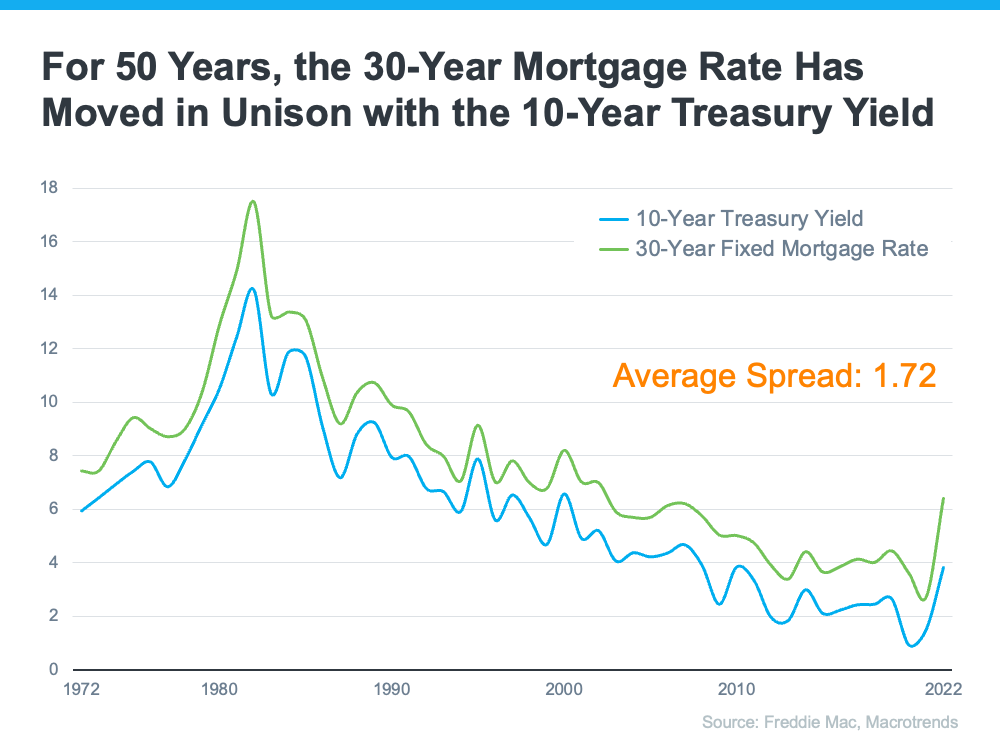
Last Friday morning, the mortgage rate was 6.85%. That means the spread was 3.2%, which is almost 1.5% over the norm. If the spread was at its historical average, mortgage rates would be 5.37% (3.65% 10-Year Treasury Yield + 1.72 spread).
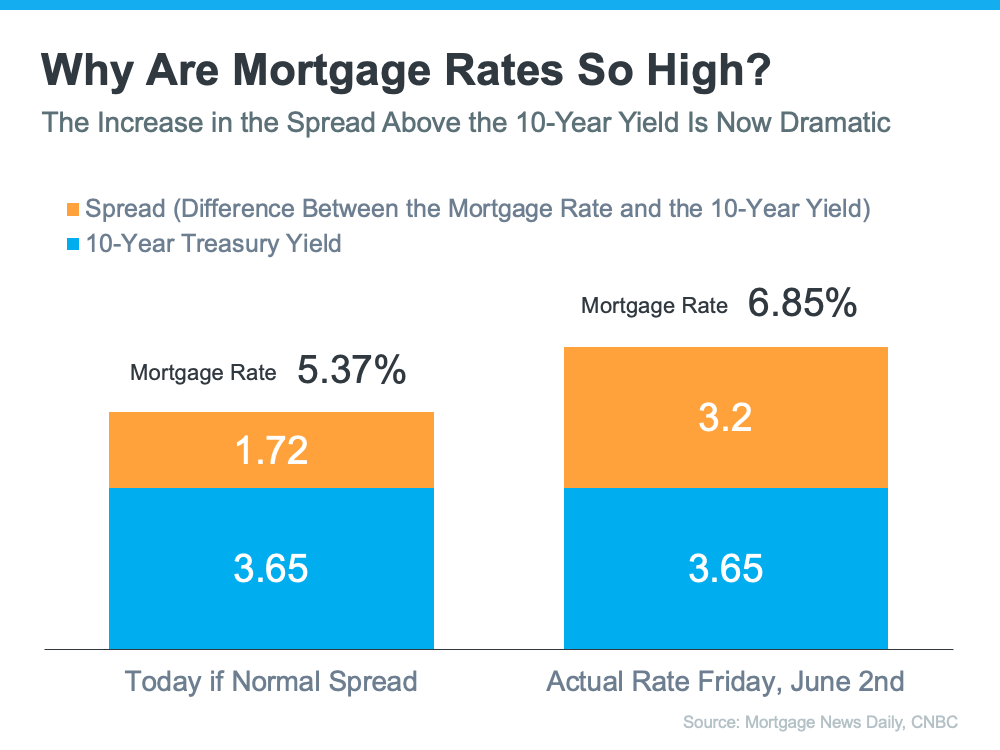
This large spread is very unusual. As George Ratiu, Chief Economist at Keeping Current Matters (KCM), explains:
“The only times the spread approached or exceeded 300 basis points were during periods of high inflation or economic volatility, like those seen in the early 1980s or the Great Financial Crisis of 2008-09."
The graph below uses historical data to help illustrate this point by showing the few times the spread has increased to 300 basis points or more:
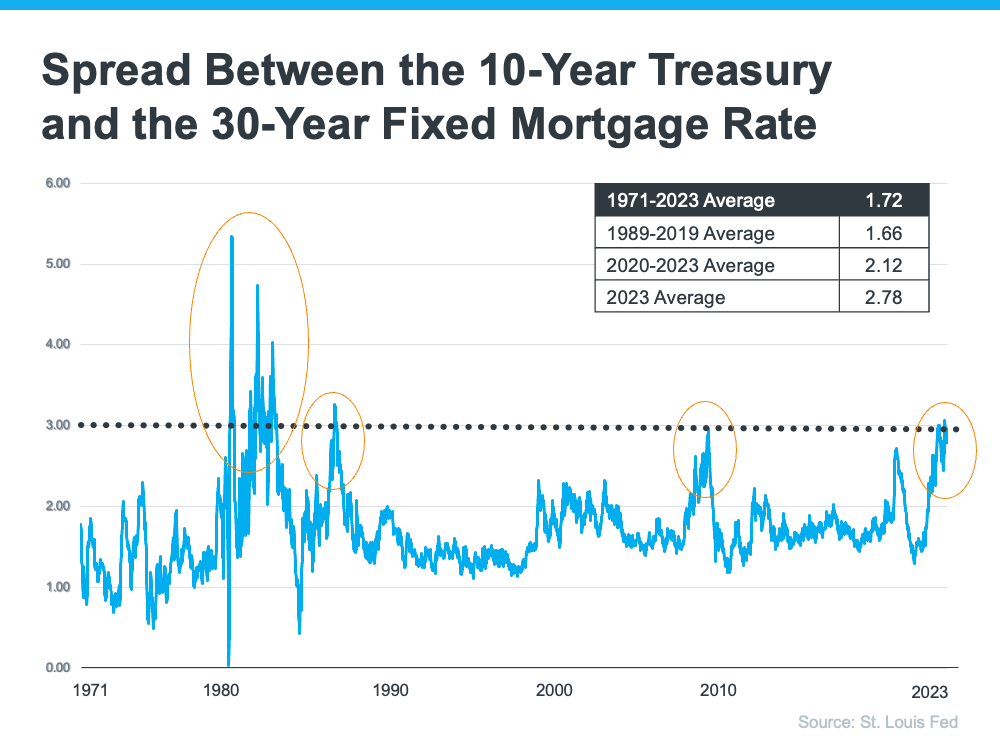
The graph shows how the spread has come down after each peak. The good news is, that means there’s room for mortgage rates to improve today.
So, what’s causing the larger spread and making mortgage rates so high today?
The demand for MBS is heavily influenced by the risks associated with investing in them. Today, that risk is impacted by broader market conditions like inflation and fear of a potential recession, the Fed’s interest rate hikes to try to bring down inflation, headlines that create unnecessarily negative narratives about home prices, and more.
Simply put: when there’s less risk, demand for MBS is high, so mortgage rates will be lower. On the other hand, if there’s more risk with MBS, demand for MBS will be low, and we’ll see higher mortgage rates as a result. Currently, demand for MBS is low, so mortgage rates are high.
2. When Will Rates Go Back Down?
Odeta Kushi, Deputy Chief Economist at First American, answers that question in a recent blog:
“It’s reasonable to assume that the spread and, therefore, mortgage rates will retreat in the second half of the year if the Fed takes its foot off the monetary tightening pedal and provides investors with more certainty. However, it’s unlikely that the spread will return to its historical average of 170 basis points, as some risks are here to stay.”
Bottom Line
The spread will shrink when the fear investors feel is eased. That’ll mean we should see mortgage rates moderate as the year goes on. However, when it comes to forecasting mortgage rates, no one can know for sure exactly what will happen.
Categories
- All Blogs 482
- Buying A Home 66
- Community Neighborhood Guides 7
- DFW Lifestyle 38
- Eat, Drink, & Shop Local 12
- First Time Home Buyer Tips 161
- Homeownership Tips & Tricks 24
- Living in Arlington, TX 7
- Living in Burleson 7
- Living in Dallas Fort Worth Metroplex 78
- Living In Texas 18
- Mansfield, TX 14
- Midlothian, TX 13
- Mortgage Rates, Financing, and Affordability 41
- New Construction & Developments in DFW 14
- Real Estate Investing 33
- Real Estate News 66
- Rentals, Property Management, & Leasing 13
- Selling Your House 163
- Texas Relocation Guide 40
- Things To Do in DFW 4
Recent Posts








MY BLOGS
- Moving from California to Texas? 12 Things You Need to Know Before Relocating to DFW So, you're thinking about leaving California and moving to Texas? First of all, welcome! Or at least, potentially welcome! Maybe you're tired of California home prices. Maybe you've accepted a job in Dallas–Fort Wor
- Is Kennedale, TX Really a Small Town? What Living in DFW’s Best-Kept Secret Is Actually Like If you’ve driven around southern Tarrant County, there’s a good chance you’ve driven near Kennedale without really thinking much about it. It’s tucked between Arlington, Mansfield and Fort Worth, and honestl
- Texas Homeowners Insurance Spikes: What DFW Buyers Need to Know Before Buying a Home You've found a house you love. The price works. The mortgage payment looks manageable. You've calculated your down payment, checked the property taxes, and maybe even negotiated some seller concessions. Then you get
- Thinking About Downsizing or Multigenerational Living? ADUs Are Changing the Way South DFW Families Use Their Homes What if downsizing didn't necessarily mean moving away from the neighborhood you love? Or what if your parents could live close by without actually living in your house? Or maybe your
MY BLOGS
- Moving from California to Texas? 12 Things You Need to Know Before Relocating to DFW
- Is Kennedale, TX Really a Small Town? What Living in DFW’s Best-Kept Secret Is Actually Like
- Texas Homeowners Insurance Spikes: What DFW Buyers Need to Know Before Buying a Home

MY BLOGS
Local News, Events & More Emailed Daily!